Be yourself; Everyone else is already taken.
— Oscar Wilde.
This is the first post on my new blog. I’m just getting this new blog going, so stay tuned for more. Subscribe below to get notified when I post new updates.
Be yourself; Everyone else is already taken.
— Oscar Wilde.
This is the first post on my new blog. I’m just getting this new blog going, so stay tuned for more. Subscribe below to get notified when I post new updates.
Tom Gregory 31026907
What is Hooke’s Law?
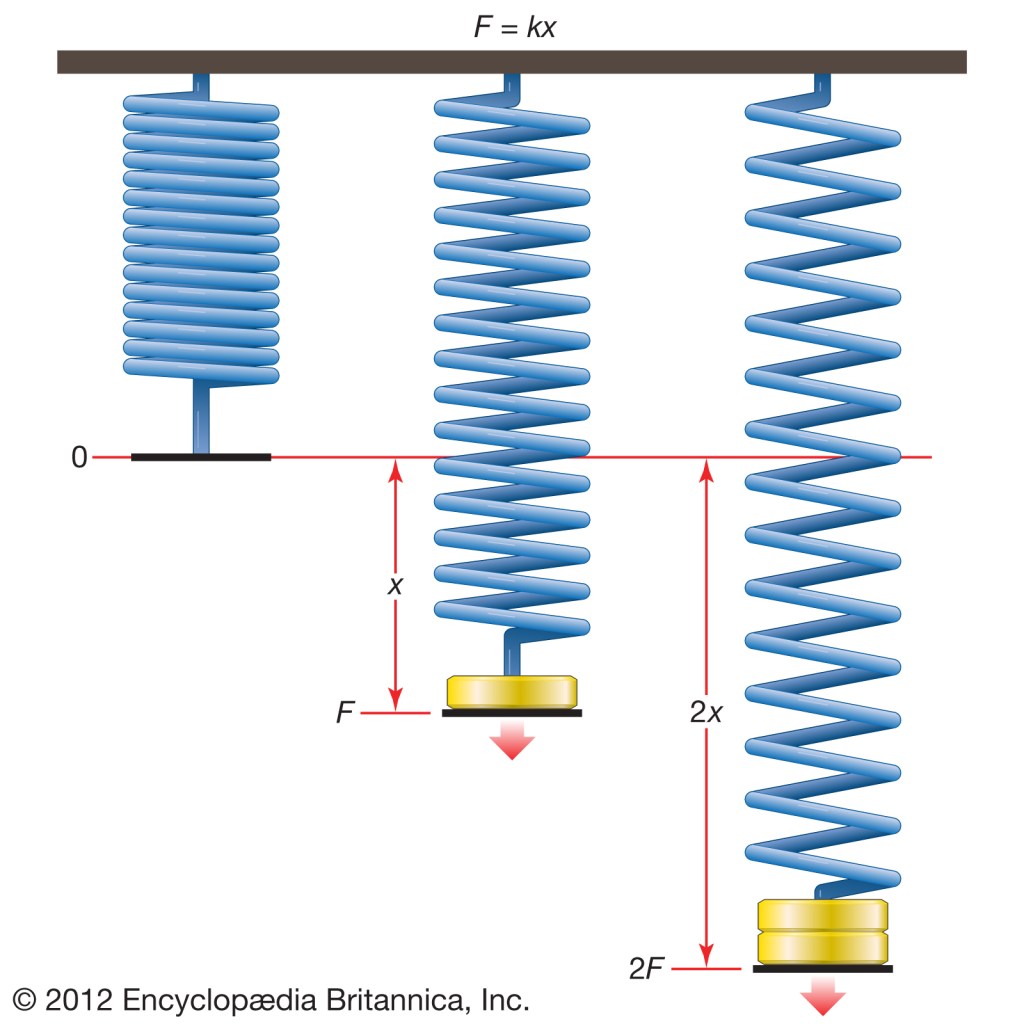
Hooke’s Law states that the extension of a spring is proportional to the force applied. Applying this principle, we can derive the equation F=-kX where F is the applied force (N); k is the spring constant which is material dependent; and X represents the extension (m). However, Hooke’s law isn’t limited to just the behaviour of springs; the deformation of an elastic body will also comply with Hooke’s Law up to the point where the applied force is great enough for the body to reach its elastic limit. If a material has been stretched beyond its elastic limit, a permanent deformation will occur, both in springs and elastic bodies alike. Figure 1 is a useful visual representation of Hooke’s Law at work, showing that doubling the force applied to the end of the same spring will double the extension of the spring. [3]
In order to investigate the principles of Hooke’s Law, an experiment was conducted in which three materials y1, y2 and z, were subjected to different levels of force, and the deformation of each material was then measured. The aim was to determine to what extent the behaviour of the three materials supported Hooke’s Law.
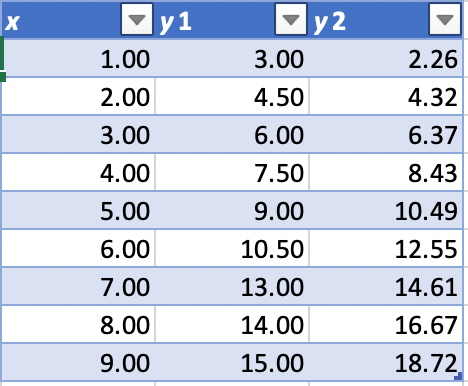
Figure 2 shows the set of results collected for two of the materials investigated. the ‘X’ column represents the force applied (F) in Newtons the the columns titled y1 and y2 present the deformation of the associated materials according to the force applied, in mm.
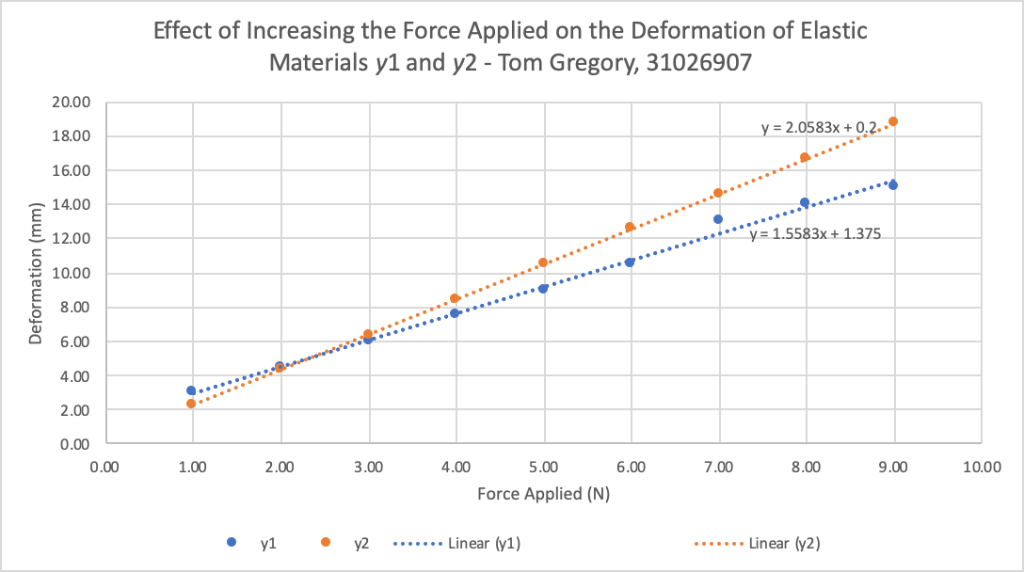
By plotting Figure 3, it is possible to determine the gradients of the trend lines for each set of result and from this, we can calculate the k value for materials y1 and y2. However, without making any calculations, it is clear that to some extent both materials support Hooke’s Law as a result of their positive linear gradients. Furthermore, we can deduce that neither material reached their elastic limit during this investigation and would therefore return to their original shapes once the force has been removed, meaning that no results must be discarded as anomalous before any calculations are made. From Figure 3, we can deduce the k value of each material, simply by dividing the force applied (1N) by the gradient of each of the trend lines. For this part, we must consider the graph as though the trend lines for both sets of results pass through the origin.
gradient of y1 = 1.5583 elasticity constant: k = 1N/1.5583 = 0.6417
gradient of y2 = 2.0583 elasticity constant: k = 1N/2.0583 = 0.4858
A higher elasticity constant (k) denotes that the material will undergo a smaller deformation given that the force applied is the same and all control variables are constant.
An unexpected feature of the graph presented in Figure 3 is that the two sets of results intersect, meaning that theoretically if a certain amount of Force is applied to both materials, the level of deformation is identical. The point at which this would occur can be calculated by putting the equations of each line equal to one another and solving the simultaneous equations. I calculated the point of intersection using the “goal seek” function on Microsoft Excel setting the difference between y1 and y2 to zero.

Figure 4 shows that the intersection point of the two sets of results occurs when x=2.35N and the resulting extension would be 5.04mm. However, as previously mentioned, the fact that these two sets of results intersect at all is surprising; linear graphs can only intersect at one point and given that according to Hooke’s Law, when no force is applied, there should be no extension/deformation of the elastic material, it would be expected that the point of intersection would be at the origin. This error may have resulted from a few possible causes; the materials y1 and y2 do not fully comply with Hooke’s Law and/or the results obtained were affected by the uncertainties of the measuring equipment or inaccurate measuring techniques. Due to the linear relationships between the force applied and the deformation, it is likely that the materials do conform with Hooke’s Law, and that the main source of error involved in this investigation resulted from the uncertainties of the measuring equipment and inaccurate measuring techniques. Furthermore, the range or results was between 2.26mm and 18.72mm meaning that the uncertainty of any measuring equipment would make up a high percentage of the values recorded.
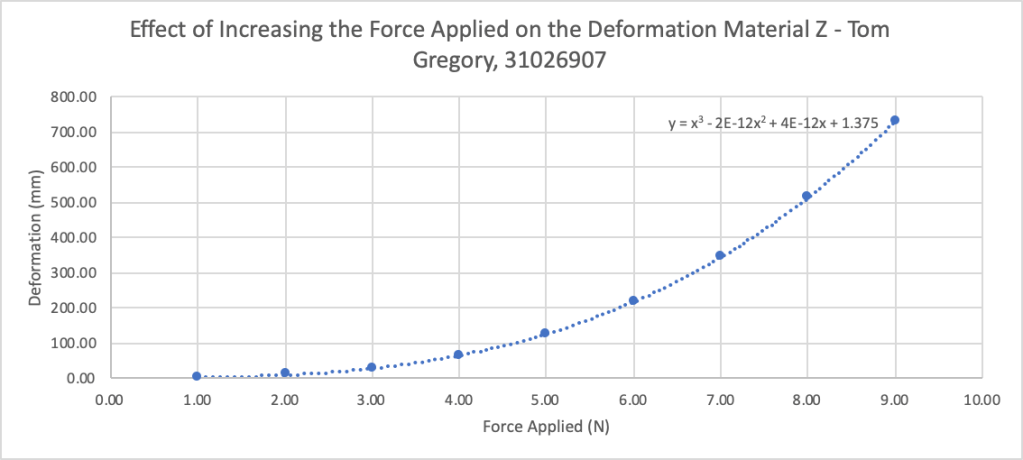
Figure 5 presents the results obtained for material z. The results obtained for material z were so significantly different from those of y1 and y2 that they have been plotted separately. The non-linear trend line indicates that the forces applied in this investigation deformed the material far beyond its elastic limit, causing plastic deformation – when the force applied causes the material to deform irreversibly, meaning that any subsequent application of force will result in an extension that is no longer necessarily proportional to the force applied [1]. as a result, it is impossible to calculate the elasticity constant of material z.
In this investigation, we cannot definitively state that materials y1 and y2 fully comply with Hooke’s Law; however, if we are to appreciate that some of the measurements may be affected by uncertainties and human error, then the linear relationships between force applied and the resulting deformation are enough to suggest that Hooke’s Law held true with these materials. On the other hand, it is clear that material z had been deformed far beyond its elastic limit meaning that Hooke’s Law did not comply with the results obtained.
To improve the accuracy of results obtained in this investigation, I would ensure that for each force applied, multiple measurements are recorded. this would have allowed for any anomalous results to be discarded, preventing them from impacting the trend line. Furthermore, I would perhaps test a wider range of Forces, as increasing the force would increase the extension; a greater extension would minimise the effect of uncertainty resulting from the measuring equipment. Also, to minimise the impacts of human error, I would ensure that each measurement is taken at eye level by at least two individuals who are conducting the investigation. This combination of improvements would hopefully provide results that comply more strictly with Hooke’s Law.
Reference list
[1] Khan Academy. (2016). What is Hooke’s Law? [online] Available at: https://www.khanacademy.org/science/physics/work-and-energy/hookes-law/a/what-is-hookes-law [Accessed 13 Nov. 2019].
[2] The Editors of Encyclopedia Britannica (2017). Hooke’s law | Description & Equation. In: Encyclopædia Britannica. [online] Available at: https://www.britannica.com/science/Hookes-law.
[3] Williams, M. (2015). What is Hooke’s Law? [online] Phys.org. Available at: https://phys.org/news/2015-02-law.html [Accessed 10 Nov. 2019].
This is an example post, originally published as part of Blogging University. Enroll in one of our ten programs, and start your blog right.
You’re going to publish a post today. Don’t worry about how your blog looks. Don’t worry if you haven’t given it a name yet, or you’re feeling overwhelmed. Just click the “New Post” button, and tell us why you’re here.
Why do this?
The post can be short or long, a personal intro to your life or a bloggy mission statement, a manifesto for the future or a simple outline of your the types of things you hope to publish.
To help you get started, here are a few questions:
You’re not locked into any of this; one of the wonderful things about blogs is how they constantly evolve as we learn, grow, and interact with one another — but it’s good to know where and why you started, and articulating your goals may just give you a few other post ideas.
Can’t think how to get started? Just write the first thing that pops into your head. Anne Lamott, author of a book on writing we love, says that you need to give yourself permission to write a “crappy first draft”. Anne makes a great point — just start writing, and worry about editing it later.
When you’re ready to publish, give your post three to five tags that describe your blog’s focus — writing, photography, fiction, parenting, food, cars, movies, sports, whatever. These tags will help others who care about your topics find you in the Reader. Make sure one of the tags is “zerotohero,” so other new bloggers can find you, too.

 An Investigation of Hooke's Law